Post
Best PetSafe Gentle Leader Head Collar Review 2026: The Humane Solution to Leash Pulling
May
PetSafe Gentle Leader Head Collar Review: The Humane Solution to Leash Pulling
If you have ever been dragged down the sidewalk by an enthusiastic dog, you know how exhausting and even dangerous uncontrolled leash pulling can be. The PetSafe Gentle Leader Head Collar is one of the most trusted and veterinarian-recommended tools for addressing this common problem in a humane, effective, and gentle way.
Unlike traditional choke chains or prong collars that apply pressure to the throat and rely on pain or discomfort as a deterrent, the Gentle Leader works with the natural anatomy of your dog to guide behavior through communication rather than correction. This fundamental difference in philosophy makes it a favorite among positive reinforcement trainers and veterinary behaviorists alike.
What Is the PetSafe Gentle Leader and How Does It Work?
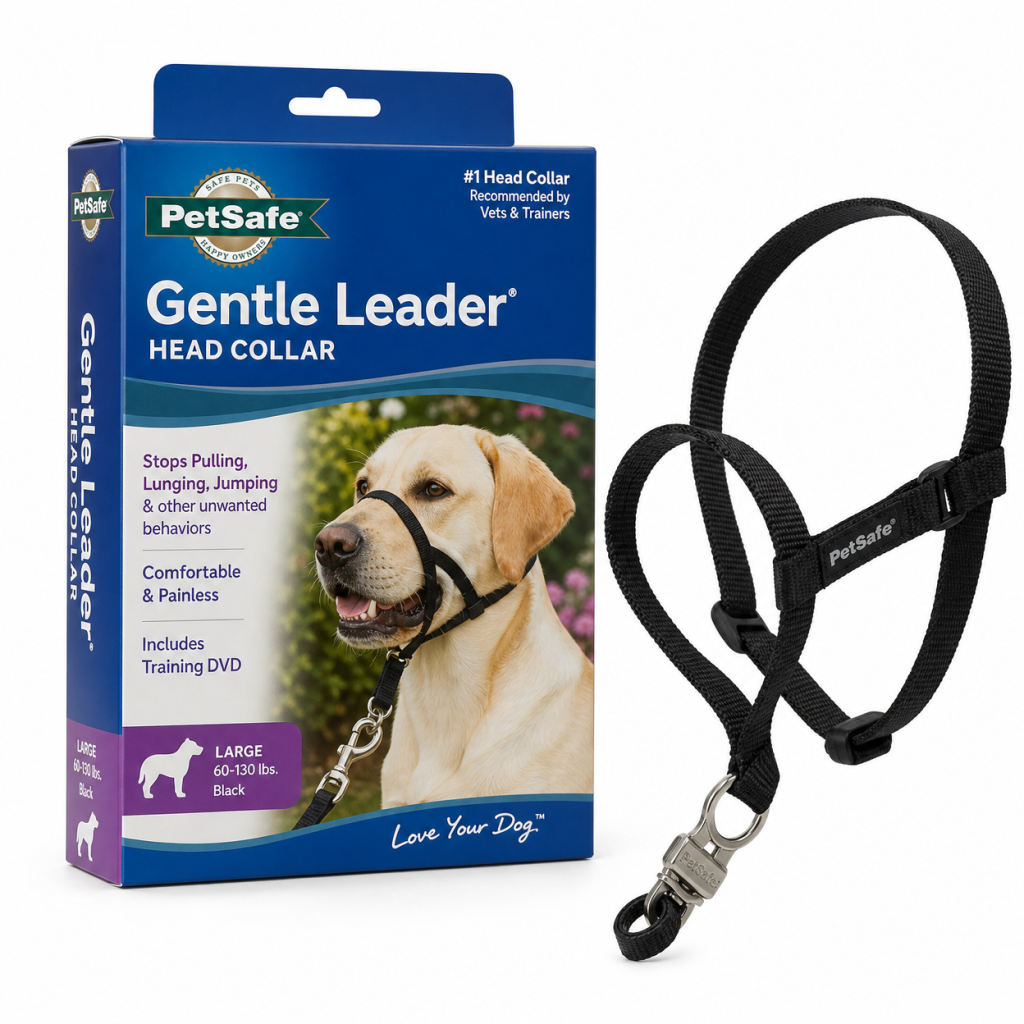
The Gentle Leader is a head collar — a training aid that fits over the dog’s muzzle and behind the ears, attaching at the chin. The design is inspired by the way horses are guided through halters. Because the attachment point is under the chin rather than at the back of the neck, when a dog attempts to pull forward, the collar gently redirects the head back toward the handler.
This head turn naturally causes the body to follow, effectively stopping the forward momentum without requiring any forceful corrections from the owner. The principle is simple but powerful: you control the head, you control the dog.
It is the same reason that a 1,000-pound horse can be guided by a lightweight halter. Dogs who understand this principle adapt to the Gentle Leader quickly, and most owners report dramatic reductions in pulling behavior within the very first walk. The collar does not gag, choke, or cause pain. Instead, it communicates direction through gentle pressure and release, which dogs learn to follow almost instinctively after a short adjustment period.
For owners who have tried harnesses that only seem to give their dog more leverage to pull, or standard collars that cause coughing and choking, the Gentle Leader offers a refreshingly different mechanical advantage. By controlling the dog’s head, you control where the body goes — eliminating the ability to brace and pull against you with full body weight.
This is particularly important for larger breeds like Labrador Retrievers, German Shepherds, and Golden Retrievers, whose pulling strength can easily overwhelm an average adult.
Design and Build Quality
The PetSafe Gentle Leader is constructed from durable nylon webbing with a padded nose loop designed for comfort during extended use. The nose band sits high on the muzzle — above the sensitive whisker area — reducing the chances of irritation. This is a critical design detail because some dogs initially resist head collars due to nose band discomfort.
By positioning the band higher and adding padding, PetSafe has minimized this issue significantly compared to earlier or cheaper head collar designs. Owners frequently note that their dogs stop pawing at the face after just a few sessions once they realize the collar does not hurt.
The neck strap features a quick-snap buckle for easy on and off, and the collar includes a sliding adjustment that allows for a precise, snug fit around the back of the skull. The leash attaches to a ring located directly under the chin, which provides the directional control described earlier.
The hardware is made from durable, rust-resistant materials that hold up well in wet conditions — important for dogs who love puddles or live in rainy climates. The snap buckle is designed to be easy to operate even with cold or wet hands, a thoughtful touch for winter walking.
Available in multiple sizes ranging from extra-small for toy breeds to large for working dog breeds, there is a Gentle Leader appropriate for virtually every dog. Size selection is based on the dog’s weight and muzzle circumference, and PetSafe provides a straightforward sizing chart to guide the process.
The collar is available in several colors, adding a small element of personal style to a functional training tool. Owners who want to match their leash or other gear will appreciate the subtle color options ranging from basic black and gray to more vibrant hues like purple and red.
One of the most appreciated aspects of the Gentle Leader’s build is how lightweight it is. Unlike bulky harnesses that can weigh down a small dog, the Gentle Leader adds almost no noticeable weight.
This encourages longer wear and faster acclimation because the dog quickly forgets it is even there — until they try to pull and feel the gentle redirection. The entire collar weighs less than a typical smartphone, yet it can control dogs over 100 pounds when fitted correctly.
Benefits of Using the Gentle Leader
The primary benefit is obvious: dramatically reduced pulling on walks. But the Gentle Leader offers several additional advantages that many owners overlook. First, it discourages lunging behavior toward other dogs, cyclists, and squirrels because the redirection mechanism kicks in immediately when a dog surges forward.
A dog that lunges while wearing a standard collar can still reach the end of the leash with force, but a dog in a Gentle Leader has their head turned away from the target the moment tension is applied, breaking focus and reducing the likelihood of a full-out charge. This makes walks in busy neighborhoods or dog-populated parks far less stressful.
Second, it can be useful for dogs that tend to jump on people, as the gentle pressure signals to the dog to redirect its energy upward and backward rather than forward onto a guest’s legs. Third, because no pressure is applied to the trachea or throat, it is an excellent choice for dogs with respiratory issues, tracheal collapse, or those that are brachycephalic breeds prone to breathing difficulties.
French Bulldogs, Pugs, and Boston Terriers often suffer from airway compromise, and a standard collar can worsen their condition dramatically. The Gentle Leader offers these breeds a safer alternative that still provides control.
The Gentle Leader is also highly effective for large, powerful breeds where owner safety is a legitimate concern. A strong adult pulling a 90-pound dog on a flat collar is asking for shoulder injuries and falls.
The Gentle Leader dramatically reduces the physical effort required to maintain control, making walks safe and enjoyable for everyone involved. Elderly owners, people with arthritis, and those recovering from injuries have all reported that the Gentle Leader allowed them to continue walking their dog safely when they had been considering rehoming or hiring a professional walker due to pulling issues. In many cases, the Gentle Leader has kept dogs in homes that might otherwise have surrendered them to shelters.
Additionally, the Gentle Leader serves as an excellent training bridge. Many owners use it for a few months while teaching loose-leash walking skills, then transition back to a flat collar or harness once the dog has learned what is expected. This makes it not just a tool for management but a genuine training aid that builds long-term good habits.
The dog learns that pressure on the face means “turn toward the handler,” and that lesson generalizes even when the Gentle Leader is removed. Over time, many dogs learn to walk politely on any equipment because the Gentle Leader taught them the concept of yielding to leash pressure.
How to Introduce the Gentle Leader to Your Dog
Many dogs initially resist wearing any type of head collar. They may paw at it, rub their face on the ground, or try to remove it. This is completely normal and does not indicate that the collar is causing pain — dogs simply find any new sensation on their face unusual.
PetSafe recommends a gradual introduction process that involves pairing the head collar with high-value treats and positive reinforcement. Rushing this process is the number one reason for failure, so patience is essential. Plan for at least a week of introduction before attempting a real walk.
Start by letting your dog sniff the collar and rewarding curiosity. Then practice putting the nose loop over the muzzle for brief moments, immediately followed by treats. Gradually increase the time the collar is worn before attaching the leash and going for actual walks.
Most dogs accept the Gentle Leader within a few days of this positive introduction approach. The key is patience and a positive, reward-based mindset throughout the process. Never force the collar onto a resistant dog, as that will create lasting negative associations that can take months to undo.
Some trainers recommend doing the introduction indoors where there are few distractions. Let the dog wear the collar for five minutes while eating dinner, then ten minutes while playing with a favorite toy. Slowly build up to longer periods.
Once the dog seems comfortable wearing the collar around the house, attach the leash and let them drag it around (supervised) so they learn that the collar does not always mean tension. Only then should you attempt an outdoor walk in a low-distraction area like your own backyard. If the dog balks, go back a step and progress more slowly.
For dogs who remain resistant after a week of patient training, some owners find success by pairing the Gentle Leader with a favorite activity. For example, put the collar on just before meal time or just before a car ride — two things most dogs love. The positive association can overcome initial resistance faster than treats alone.
Others have success by applying a small amount of peanut butter to the inside of the nose band, encouraging the dog to put their nose into it voluntarily. However you proceed, remember that force and frustration are counterproductive. A calm, patient owner produces a calm, accepting dog.
Comparing the Gentle Leader to Alternative No-Pull Solutions
The market for no-pull solutions includes front-clip harnesses, back-clip harnesses, and various types of head collars. Each has its place, and the best choice depends on the individual dog’s temperament and training history. The Gentle Leader tends to produce faster results than front-clip harnesses for powerful pullers, because the head control mechanism is fundamentally more effective at interrupting pulling behavior at its source.
A front-clip harness works by turning the dog’s shoulders when they pull, but a truly determined puller can still make progress. The Gentle Leader turns the head, which is far more disorienting and effective. For dogs that have learned to lean into a harness and pull like a sled dog, the Gentle Leader is often the only thing that works.
However, some dogs genuinely hate head collars and will not adapt to them despite patient introductions — for those dogs, a quality front-clip harness may be the better option. Similarly, dogs with very short snouts (brachycephalic breeds) may find even a well-fitted head collar uncomfortable due to their facial structure.
In those cases, a front-clip harness like the Freedom Harness or Ruffwear Front Range is often a better choice. The key is to observe your dog’s body language. If they are constantly stressed or unhappy after two weeks of proper introduction, try something else. No single tool works for every dog.
Compared to aversive tools like prong collars and choke chains, the Gentle Leader offers the significant advantage of not causing pain or fear as a training mechanism. This is not only more humane but also more effective in the long run, as aversive methods often create anxiety and can worsen reactive behaviors in some dogs.
A dog trained with a prong collar may learn to suppress pulling out of fear of pain, but that same dog may explode aggressively if the collar fails or is removed. A dog trained with a Gentle Leader learns to yield to gentle pressure because it is a communication tool, not a punishment device. The relationship between handler and dog remains positive and trusting.
It is also worth noting that many dog training facilities, daycares, and boarding kennels allow Gentle Leaders but prohibit prong and choke collars due to safety and liability concerns.
If you use a Gentle Leader, you will likely be able to continue using it in group settings, whereas prong collar users are often asked to remove or replace their equipment. This makes the Gentle Leader a more versatile choice for owners who utilize multiple pet services.
Who Should Use the Gentle Leader?
The PetSafe Gentle Leader is an excellent choice for first-time dog owners who have a dog that pulls on walks but do not want to resort to aversive training methods. It is also widely recommended by professional trainers and veterinary behaviorists as a management tool during the process of teaching loose-leash walking through positive reinforcement.
It is particularly well-suited for large, energetic breeds like Labradors, German Shepherds, Golden Retrievers, and similar working dogs whose pulling strength exceeds what most owners can physically manage on a flat collar or back-clip harness. For these breeds, the Gentle Leader can be the difference between daily walks and no walks at all.
Dog owners who compete in obedience, agility, or rally sports should note that the Gentle Leader is typically not permitted in competition rings. In these cases, it functions best as a management and training tool outside of formal training sessions, while the dog simultaneously learns loose-leash skills through positive reinforcement training that eventually transfers to a flat collar or martingale.
Many competition handlers use the Gentle Leader for daily walks and warm-ups, then switch to a show-legal collar for actual competition. This approach gives the dog clear expectations: the Gentle Leader means casual walking, the flat collar means serious work.
Senior dogs with arthritis or mobility issues can also benefit from the Gentle Leader, as it reduces the jerking and pulling that can exacerbate joint pain. Similarly, dogs recovering from surgery — such as ACL repair — should not be subjected to the sudden forces of pulling on a standard collar. The Gentle Leader’s smooth redirection protects healing tissues while still allowing the dog to enjoy outdoor time. For these medical cases, the Gentle Leader is often recommended by veterinarians as part of a post-operative management plan.
One group that may not benefit are dogs who are extremely fearful or anxious. For these dogs, any novel equipment on the face can be too stressful, regardless of how gentle the introduction. In such cases, working with a veterinary behaviorist to address the underlying fear before introducing head collar training is the better course. The Gentle Leader is a training tool, not a cure for anxiety, and should be used only when the dog is emotionally ready.
Care and Maintenance
The Gentle Leader is machine washable on a gentle cycle using mild detergent, making it easy to keep clean after muddy outdoor adventures. Allow it to air dry to preserve the integrity of the webbing and hardware. Inspect the collar regularly for signs of wear, particularly at the attachment points and buckles, and replace it if any structural compromises are detected.
A worn buckle or frayed strap can fail at a critical moment, so replacing the collar every year or two with heavy use is reasonable. The cost of a new collar is small compared to the cost of a dog lost because their equipment failed.
For daily cleaning between washes, a damp cloth can wipe away dirt and saliva. The nose band tends to collect debris and should be checked after every walk, especially if your dog likes to sniff in mud or sand. Storing the collar hanging up rather than folded will prevent creases that can weaken the webbing over time. If you live in a humid environment, ensure the collar is completely dry before storage to prevent any mildew odor from developing on the nylon.
Final Verdict
The PetSafe Gentle Leader Head Collar is a thoughtfully engineered, veterinarian-recommended training tool that genuinely delivers on its promise of reducing leash pulling through humane, effective head control. It requires a patient introduction process, but the payoff for most dog owners is transformative — walks that were previously stressful ordeals become genuinely enjoyable experiences.
For owners committed to positive, force-free training approaches who need an effective management tool to complement their training efforts, the Gentle Leader earns its position as one of the most popular and respected no-pull solutions available today. It is a worthwhile investment in both your own quality of life and your dog’s ongoing training journey. For the vast majority of dogs who pull, the Gentle Leader is the kindest, most effective first step toward better walks.
