Post
Herm Sprenger Prong Training Collar: A Balanced Training Professional’s Perspective
May
Herm Sprenger Prong Training Collar: A Balanced Training Professional’s Perspective
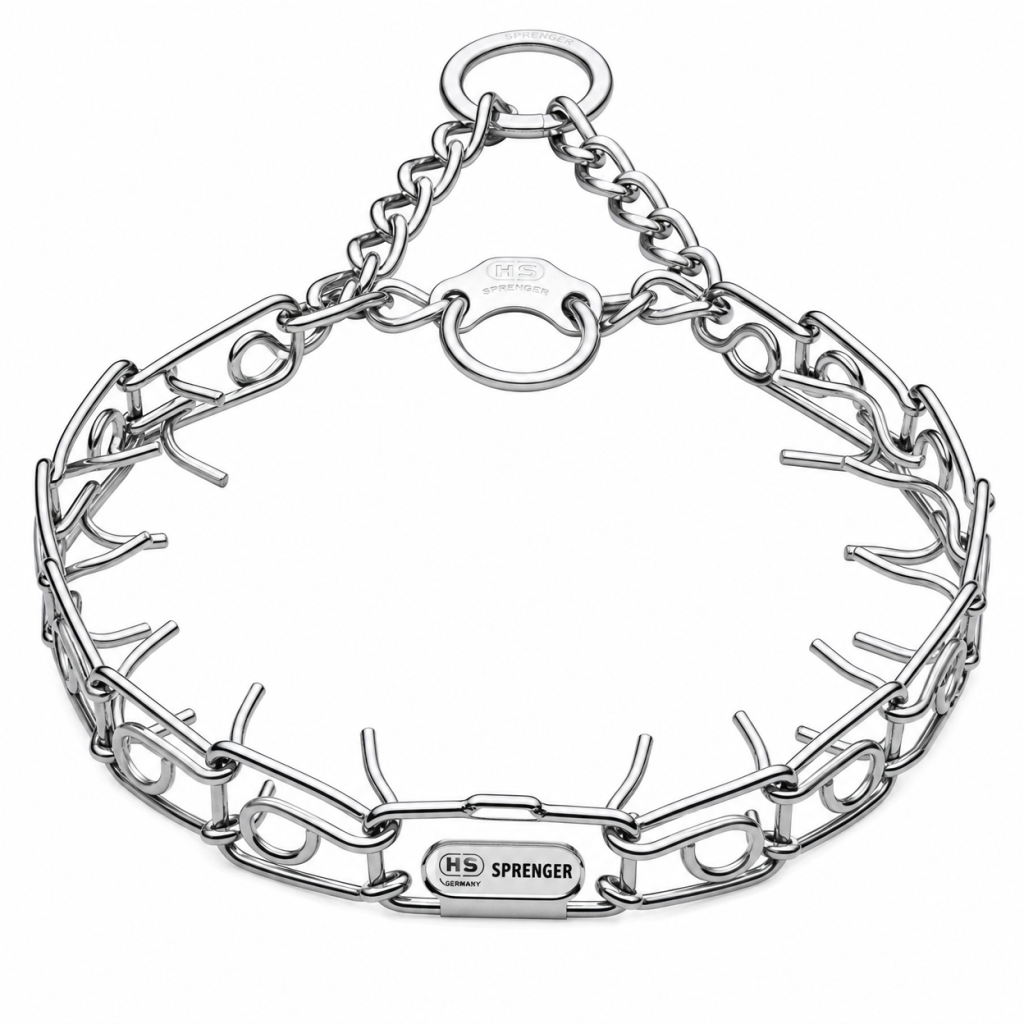
Few pieces of dog training equipment generate as much debate as the prong collar. For those unfamiliar with balanced training approaches, the sight of a Herm Sprenger Prong Training Collar — with its interlocking metal links and inward-facing prongs — can appear alarming. Yet many of the world’s top professional dog trainers, police and military K9 handlers, and competitive sport dog handlers use Herm Sprenger prong collars as important tools in a comprehensive training toolbox. This review examines the collar from an objective, information-forward perspective to help you make an informed decision about whether this tool might be appropriate for your specific dog and situation. The goal is not to advocate for or against prong collars but to provide accurate information so you can decide for yourself.
Understanding How the Prong Collar Functions
The prong collar operates on a fundamentally different mechanism than most people assume when seeing it for the first time. The prongs do not stab or puncture — they apply even, distributed pressure around the circumference of the dog’s neck when tension is applied, mimicking the natural correction that a mother dog applies to puppies with her mouth. The sensation is pressure, not pain, when used correctly. When leash tension is released, all pressure immediately disappears, providing clear communication that desired behavior has been achieved. This “pressure on, pressure off” communication is similar to how a gentle leader works, just with a different application point. The difference is that the prong collar applies pressure around the entire neck rather than just the face.
The key phrase is “when used correctly.” Like any training tool — from a clicker to a head collar to a remote trainer — the prong collar can cause harm if misapplied. It should never be left on an unsupervised dog, should not be used as a regular collar, and should only be used with guidance from an experienced trainer who can demonstrate proper fit, application, and handling technique. When used incorrectly — yanking, jerking, or leaving it on for long periods — the prong collar can cause injury. But used as intended, it is a precise communication tool. The difference between a humane prong collar correction and an abusive one is about two pounds of pressure and proper timing.
The prong collar is often described as providing “power steering” for powerful dogs. A 100-pound German Shepherd that ignores a flat collar and even many harnesses will respond to the lightest pressure from a properly fitted prong collar, allowing the handler to communicate with a mere finger movement rather than a full-arm yank. This is why police and military K9 handlers use them — not because they want to hurt dogs, but because they need absolute reliability in high-stakes situations. A prong collar allows a handler to redirect a dog’s attention from a threat with minimal physical effort.
Why Herm Sprenger Is the Standard
Not all prong collars are created equal, and Herm Sprenger’s dominance among professional trainers reflects genuine quality differences. The company has been manufacturing dog training equipment in Germany since 1874, and their prong collars are machined to tolerances and surface finishes that cheap imported versions cannot match. The prongs are smooth and rounded at their tips, the links snap together with positive precision, and the stainless steel construction resists corrosion even in wet working conditions. Cheap prong collars often have sharp edges, inconsistent link sizes, and plating that flakes off, exposing base metals that can cause skin reactions. These cheap collars are genuinely dangerous, and their existence gives all prong collars a bad reputation.
The uniformity of the Herm Sprenger links ensures that pressure is applied truly evenly around the neck, which is both safer and more effective than cheap collars where irregular link quality creates inconsistent pressure distribution. Professionals who work with these collars every day recognize the quality difference immediately, which is why Herm Sprenger commands a premium price and maintains a loyal following among serious trainers. The collar also comes in a quick-release version, where the collar can be removed without unfastening each link individually — a convenience feature professionals appreciate when working with multiple dogs or needing to remove the collar quickly for safety.
Herm Sprenger offers several prong sizes (2.25mm, 3.0mm, 4.0mm) to match the dog’s coat thickness and sensitivity. The smaller prongs are for short-haired, sensitive breeds; the larger prongs for thick-coated dogs like Huskies and German Shepherds. This customization is another reason professionals prefer the brand. Using the wrong prong size can be ineffective (too small prongs may not be felt through thick fur) or uncomfortable (too large prongs on a thin-coated dog). Herm Sprenger’s range ensures you can get the right tool for your specific dog.
Sizing and Proper Fit
Herm Sprenger prong collars are available in multiple sizes and prong gauges to accommodate dogs from small to giant breeds. Proper sizing is critical: the collar should sit high on the neck just behind the ears, and when correctly fitted, there should be no slack — the collar should be snug without being constrictive when leash tension is absent. The number of links is adjusted by adding or removing them to achieve the correct fit for the individual dog’s neck size. A collar that is too loose will slide down to the base of the neck, where it is both ineffective and potentially dangerous. A collar that is too tight will cause continuous discomfort and cannot release pressure properly.
The collar should never sit low on the neck near the shoulders, where pressure application is both less effective and potentially more harmful. Proper placement high on the neck is essential for both effectiveness and safety, and this is one of the primary reasons working with an experienced trainer before using a prong collar is strongly recommended for first-time users. Many owners are surprised to learn that a prong collar should be fitted so tightly that it would be uncomfortable as a normal collar — but because it is only worn during active training sessions, this tight fit is safe and functional. The collar should be removed immediately after the training session ends.
To size a Herm Sprenger collar, wrap it around the dog’s neck high up behind the ears. You should be able to fit one finger between the prong tips and the dog’s skin, but not two. If you can fit two, the collar is too loose. Remove or add links until this fit is achieved. The collar should be snug enough that it does not rotate around the neck but loose enough that you can easily slide a finger underneath. This precise fit is what allows the collar to work with light pressure rather than requiring hard yanks.
Appropriate Candidates for Prong Collar Training
Prong collars are most commonly and appropriately used for dogs that have not responded to other training approaches and that present physical management challenges due to their size and pulling strength. Large, powerful breeds like German Shepherds, Rottweilers, Mastiffs, and similar dogs can physically outmatch their handlers on flat collars, creating genuine safety risks. In these cases, a properly used prong collar can provide a level of communication and control that allows training to proceed safely. Without such a tool, many owners would simply stop walking their dog, leading to a cascade of behavioral and health problems from lack of exercise. For these dogs, a prong collar can be the difference between a lifetime of confinement and an active, healthy life.
Prong collars are not appropriate for puppies, for dogs with neck injuries or anatomical issues, for extremely fearful or anxious dogs where the additional stimulus could increase stress, or for any situation where the handler does not have proper guidance on correct use. They are a precision tool that requires competent application, not a quick fix for training problems rooted in other causes. For reactive dogs, a prong collar used by an inexperienced handler can worsen reactivity by pairing the trigger (another dog, a stranger) with the sensation of collar pressure. A skilled handler, however, can use the prong collar to redirect attention and create positive associations. The tool is neutral; the skill of the handler determines the outcome.
Maintenance and Inspection
Herm Sprenger prong collars should be inspected before each use to ensure all links are properly connected and all prong tips remain smooth and rounded. Any link that shows signs of cracking, sharp edges, or compromised connection should be replaced immediately. The collar can be cleaned with mild soap and water and should be dried thoroughly before storage to prevent surface corrosion even on the high-quality stainless steel. A small amount of mineral oil on the moving parts every few months keeps the action smooth. Links that become stiff to open and close should be oiled or replaced.
Links that become difficult to snap together should be replaced, as a collar that comes apart during training is dangerous. Herm Sprenger sells individual replacement links, so you do not need to buy an entirely new collar if one link fails. It is wise to keep a few spare links in your training kit, as links can be lost when removing the collar. Regular inspection takes only a few seconds but can prevent a catastrophic failure in the field.
The Balanced Training Context
It is worth emphasizing that professional trainers who use prong collars do so as part of a comprehensive training approach that includes extensive positive reinforcement, relationship building, and clear communication. The prong collar is not a substitute for training — it is a communication tool used within a broader training program. Dogs trained by skilled balanced trainers using prong collars as part of a complete program achieve excellent outcomes and are often better trained and more confident than dogs where training has been incomplete or inconsistent regardless of method. The prong collar allows clear communication, but it does not replace teaching the dog what to do.
In the hands of a novice, a prong collar is a risk. In the hands of a professional, it is a refined instrument. If you are considering using a prong collar, invest first in a few sessions with a balanced trainer who can teach you proper technique. The cost of training is far less than the cost of rehabilitating a dog traumatized by misuse of equipment. A good trainer will also help you determine whether a prong collar is even appropriate for your dog — many dogs do not need one, and many problems can be solved with other methods first.
Final Verdict
The Herm Sprenger Prong Training Collar is a precision training tool that, in the right hands and applied correctly as part of a comprehensive balanced training program, is both effective and humane. The quality of construction is genuinely superior to all alternatives in its category. Dog owners considering this collar should do so with appropriate professional guidance, a clear understanding of the correct application, and a commitment to the broader training investment that makes any training tool effective. Used correctly, it can be an invaluable tool for managing and training powerful dogs safely and effectively. Used incorrectly, it can cause harm. The difference is entirely in the hands of the handler.
