Post
KONG Naturals Premium Catnip: Why Your Cat Deserves the Best Herb 2026
May
KONG Naturals Premium Catnip: Why Your Cat Deserves the Best Herb
Catnip is one of the most fascinating naturally occurring behavioral stimulants in the animal kingdom — a plant in the mint family whose essential oil compound nepetalactone triggers a euphoric, playful response in approximately 50 to 70 percent of domestic cats through interaction with their olfactory system. Not all catnip products deliver this response equally, however, and the quality difference between premium and budget catnip products is significant enough to affect whether your cat has a genuinely enriching experience or merely sniffs and walks away. KONG Naturals Premium Catnip represents the quality end of the catnip spectrum, and understanding why reveals a great deal about what makes catnip effective. For cats that respond, the difference between good catnip and bad catnip is the difference between a five-minute sniff and a fifteen-minute euphoric play session.
What Makes Premium Catnip Different
The nepetalactone content of catnip — the compound responsible for the behavioral response — degrades rapidly when exposed to air, light, and heat. Catnip that has been poorly processed, stored in inappropriate conditions, or simply has been sitting on a store shelf for extended periods loses potency progressively, sometimes to the point where the cat receives insufficient nepetalactone exposure to trigger a response. Low-quality catnip often consists largely of stem and lower leaf material, which has lower nepetalactone concentration than the flowers and upper leaf material. You might be buying catnip, but what you are getting is mostly stem.
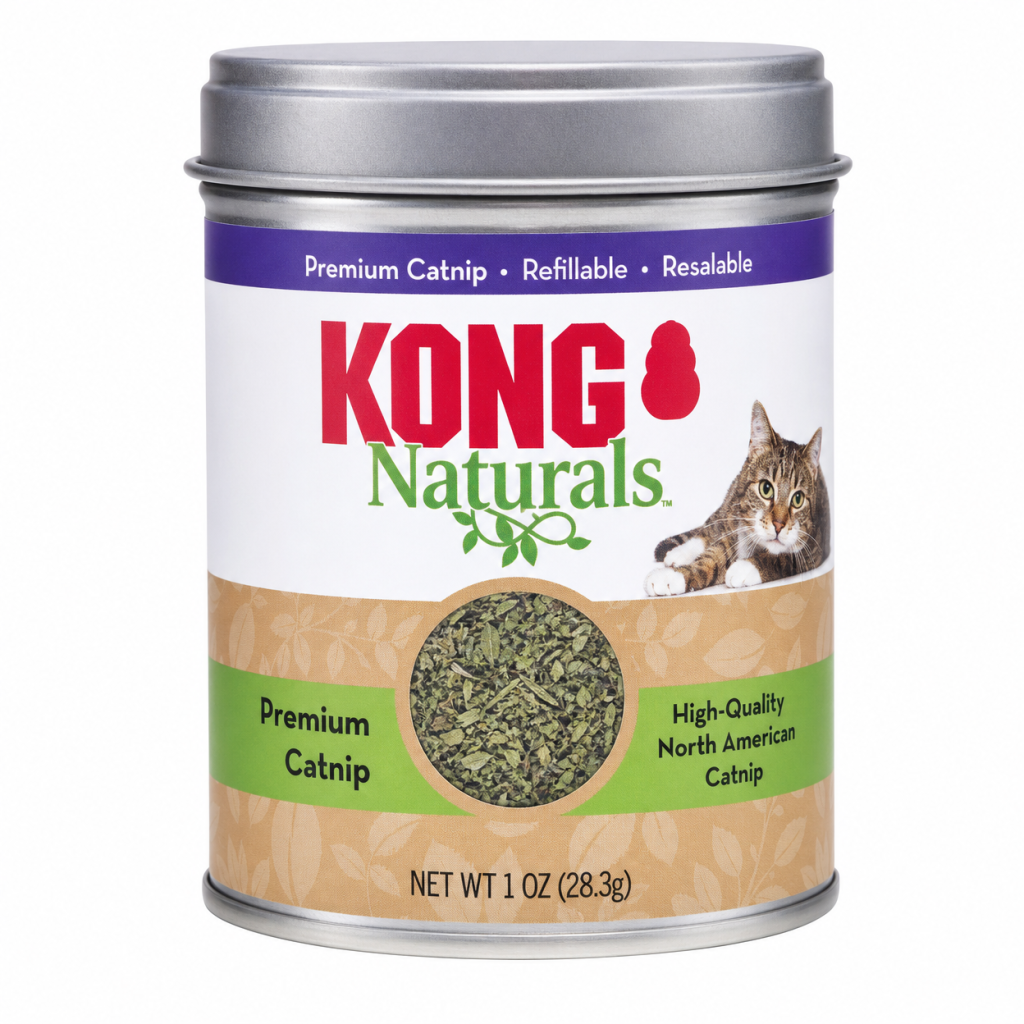
KONG Naturals Premium Catnip is harvested from North American-grown Nepeta cataria plants, processed to focus on the highest-potency portions of the plant including flowers and leaf material, and packaged in resealable containers that protect the nepetalactone content from air degradation between uses. The result is a significantly more potent catnip that reliably triggers behavioral responses even in cats that have had limited positive experiences with lower-quality alternatives. The difference is immediately apparent when you open the container — premium catnip smells strongly of mint and essential oils, while low-quality catnip has little to no scent.
The harvesting and processing methods matter enormously. KONG Naturals catnip is hand-harvested at the peak of potency, when the nepetalactone concentration in the plant is highest. The plant material is then dried slowly at low temperatures to preserve the volatile oils, rather than flash-dried at high temperatures which drives off the essential oils. After drying, the catnip is gently crumbled, not ground into a fine powder. Grinding creates more surface area for oxidation, accelerating potency loss. The crumbled format preserves potency longer and provides a more satisfying texture for cats to roll in.
Premium catnip is also tested for potency. KONG Naturals uses third-party testing to verify nepetalactone content, ensuring that every batch meets their standards. Cheap catnip manufacturers do not perform such testing; their product might be potent one batch and useless the next. With KONG Naturals, you know what you are getting. This consistency is important because cats can become frustrated if catnip does not produce the expected response. An inconsistent product can actually reduce your cat’s interest in catnip over time.
The Catnip Response Explained
When a catnip-responsive cat encounters KONG Naturals Premium Catnip, the behavioral response typically unfolds over several stages over the course of approximately five to fifteen minutes. Initial investigation involves sniffing and rubbing the face and chin against the catnip, which releases additional nepetalactone and deepens the olfactory exposure. The cat may also lick or chew the catnip, which releases more oils. This initial phase is often marked by intense focus and apparent intoxication as the nepetalactone molecules bind to receptors in the cat’s nasal passages, triggering a neurological response.
This is followed by the characteristic rolling, vocalizing, and what appears to be a state of euphoric playfulness that many people describe as the cat appearing briefly intoxicated. Cats may roll on their backs, kick their hind legs, drool, make chirping or chattering sounds, and engage in mock hunting behaviors. Some cats become more affectionate during this phase, rubbing against their owners or kneading the catnip source. Others become intensely focused on the catnip itself, ignoring everything else around them. The response varies by individual cat, but the common thread is a state of heightened arousal and pleasure.
The response then transitions to a recovery period during which the cat ignores the catnip, after which the response can be triggered again once the cat’s olfactory receptors reset, typically after thirty minutes to an hour. This refractory period is a natural protection mechanism; it prevents the cat from overstimulating their olfactory system. After the recovery period, the same catnip can trigger another response, though usually less intense than the first. For maximum effect, offer fresh catnip after the cat has had time to reset.
Catnip is completely safe for cats — it is not addictive, does not cause harm, and the response naturally self-limits through the olfactory habituation that creates the refractory period. For cats that respond to it, catnip provides a genuinely enriching experience that reduces stress, encourages physical activity, and provides sensory stimulation that supports behavioral health. It is not a drug in the human sense; it is more like a key that unlocks a natural play response. The cat is not “high” in the way a human would be; they are simply experiencing an intense version of their natural predatory and play behaviors.
Methods of Catnip Application
KONG Naturals Premium Catnip can be used in multiple ways to maximize its enrichment value. The simplest application is sprinkling a small amount directly on the floor or on a dedicated mat and allowing the cat to roll in it. This method provides the most direct olfactory exposure and is often the most intensely stimulating. The cat can rub their face, roll their body, and kick their hind legs in the catnip, experiencing the oils through multiple sensory channels. This is the method to use when you want to provide a short, intense enrichment session.
A slightly more interactive approach is stuffing loose catnip into a KONG or other stuffable toy, allowing the cat to both manipulate the toy and access the catnip. This extends the duration of the experience because the cat has to work to access the catnip. The toy also provides an outlet for the kicking and biting behaviors that accompany the catnip response, preventing the cat from destroying your carpet or furniture. The KONG shape is particularly good because it bounces unpredictably when the cat bats it, adding a play element to the catnip experience.
Catnip can also be rubbed on existing toys that the cat has lost interest in to refresh their appeal, sprinkled on scratching posts to encourage appropriate scratching behavior in a desired location, or used to refresh catnip-stuffed toys that have lost their potency over time. A few drops of catnip oil (available separately) can revive an old toy even more effectively than crumbled catnip. For scratching posts, rubbing catnip into the sisal fibers encourages the cat to scratch in that location, which can redirect them away from furniture.
For cats who are stressed or anxious, catnip can be used as part of a calming routine. Sprinkle a small amount on a favorite resting spot before a potentially stressful event, such as a visit from guests or a trip to the vet. The catnip-induced relaxation can help the cat cope with the stressor. However, note that not all cats respond to catnip with relaxation; some become more active and playful. Know your cat’s individual response before using catnip for calming purposes.
Storage for Maximum Potency
The resealable package of KONG Naturals Premium Catnip helps preserve potency between uses, but additional storage steps further protect the product’s effectiveness. Transferring the catnip to an airtight glass jar and storing it in a cool, dark location — a cabinet rather than a countertop — minimizes the oxidation and light exposure that degrade nepetalactone. Glass is preferable to plastic because plastic can absorb the essential oils and may also off-gas chemicals that could affect the catnip. A dark glass jar (amber or cobalt blue) provides additional light protection.
Freezing catnip between uses is the most effective method of preserving potency over extended periods, as the low temperature dramatically slows oxidative degradation. Portion the catnip into small, airtight freezer bags or containers, and thaw only what you need for a week or two. Repeated freezing and thawing can cause condensation, which degrades catnip, so portioning is important. Frozen catnip can retain potency for a year or more, while catnip stored at room temperature loses significant potency within six months.
Do not store catnip in direct sunlight or near heat sources such as radiators, ovens, or sunny windows. Heat accelerates the breakdown of nepetalactone, just as light does. A cool, dark pantry or closet is ideal. Also avoid storing catnip in high-humidity environments, as moisture can cause mold growth and also degrades the essential oils. If your catnip develops an off smell or shows any sign of mold, discard it immediately.
When you open a new container of KONG Naturals Premium Catnip, note the date. Write the date on the container with a marker. Catnip is best used within six months of opening, though frozen catnip can last longer. If the catnip no longer produces a response in a cat who normally responds, it has likely lost potency and should be replaced. Do not assume that the cat has “lost interest” in catnip; they may simply be responding to a degraded product.
Non-Responsive Cats and Alternatives
For the approximately 30 to 50 percent of cats that do not respond to catnip due to a genetic absence of the nepetalactone receptor, KONG Naturals also offers silver vine products, which trigger a similar but neurologically distinct response that many catnip-non-responsive cats experience strongly. Understanding whether your specific cat responds to catnip or silver vine — or potentially both — is valuable information for maximizing the enrichment value of herbal stimulants in your cat’s routine. Some cats who ignore catnip will go wild for silver vine.
Silver vine (Actinidia polygama) contains multiple active compounds, including actinidine and dihydroactinidiolide, that affect cats differently than nepetalactone. The response to silver vine is often more intense and longer-lasting than the response to catnip, even in cats who do respond to catnip. Silver vine also seems to affect a higher percentage of cats overall — some studies suggest up to 80 percent of cats respond to silver vine, compared to 50-70 percent for catnip. For cats who show no response to catnip, silver vine is the next thing to try.
Other alternatives include valerian root and Tatarian honeysuckle. Valerian root produces a response in some cats who do not respond to catnip or silver vine, though the smell is unpleasant to most humans (it has been compared to dirty socks). Tatarian honeysuckle is another alternative, though it is less widely available and its effects are less studied. KONG Naturals offers a variety pack that includes catnip, silver vine, and valerian, allowing you to test which your cat prefers without buying multiple full-sized products.
If your cat does not respond to any of these herbal stimulants, do not be discouraged. Some cats simply lack the genetic receptors for all of these compounds. These cats can still be enriched through other means, such as interactive play, food puzzles, and environmental enrichment. The absence of a catnip response does not indicate anything wrong with your cat; it is simply a genetic variation, like some humans being unable to smell certain compounds.
Final Verdict
For cats that respond to catnip, providing the highest quality product available meaningfully improves the enrichment value of the experience. KONG Naturals Premium Catnip delivers consistent, reliable responses through premium plant material, optimal processing, and quality packaging that preserves potency. It is a straightforward, low-effort, high-reward enrichment tool that is appropriate for regular inclusion in any catnip-responsive cat’s routine. The quality difference between premium catnip and budget alternatives is real and noticeable, making KONG Naturals the sensible choice for cat owners committed to providing the best experience for their feline companions. Your cat deserves the good stuff.
