Post
Go Pet Club 72-Inch Cat Tree: The Ultimate Multi-Level Playground for Curious Cats
May
Go Pet Club 72-Inch Cat Tree: The Ultimate Multi-Level Playground for Curious Cats
Cats are natural climbers, hunters, and explorers whose behavioral needs include elevated resting spots, scratching surfaces, and opportunities for play and observation that the typical household environment fails to provide. The Go Pet Club 72-Inch Cat Tree addresses these needs comprehensively in a single piece of furniture that transforms any room into a feline enrichment environment. At six feet tall, this cat tree provides cats with the height advantage they instinctively seek while offering multiple activity zones across its structure. For indoor cats who would otherwise spend their days confined to floor level, this cat tree opens up a vertical world of exploration and comfort.
Understanding Why Cats Need Vertical Space
Before evaluating any specific cat tree, understanding why cats need vertical territory is important context. In their natural environment, cats use height as both a safety mechanism and a predatory advantage — elevated positions provide escape routes from threats at ground level and clear sightlines for hunting prey. In the domestic environment, this instinct translates into cats seeking out the tops of bookshelves, refrigerators, and any other elevated surface available to them. A tall cat tree redirects this behavior to a designated, safe, and appropriate structure. Instead of your cat climbing your curtains or knocking over your books, they can climb the cat tree.
Vertical territory also reduces conflict in multi-cat households by expanding the effective living space available to each cat. When cats can establish different levels as individual territories, the perceived space of the environment increases significantly, reducing resource competition and associated inter-cat tension. The Go Pet Club’s multiple levels and separate resting platforms make it particularly valuable in homes with multiple cats. In a multi-cat home, the cat tree becomes a vertical condominium where each cat can claim their own floor, reducing fights over prime resting spots.
Providing vertical space is especially important for indoor cats who lack the environmental complexity of outdoor life. Outdoor cats have trees, fences, roofs, and other structures to climb. Indoor cats have only what you provide. A cat tree like the Go Pet Club 72-inch model gives indoor cats the opportunity to express their natural climbing instincts, exercise their muscles, and survey their territory from a safe height. This environmental enrichment has been shown to reduce stress-related behaviors such as over-grooming, inappropriate elimination, and aggression.
Structure and Platform Design
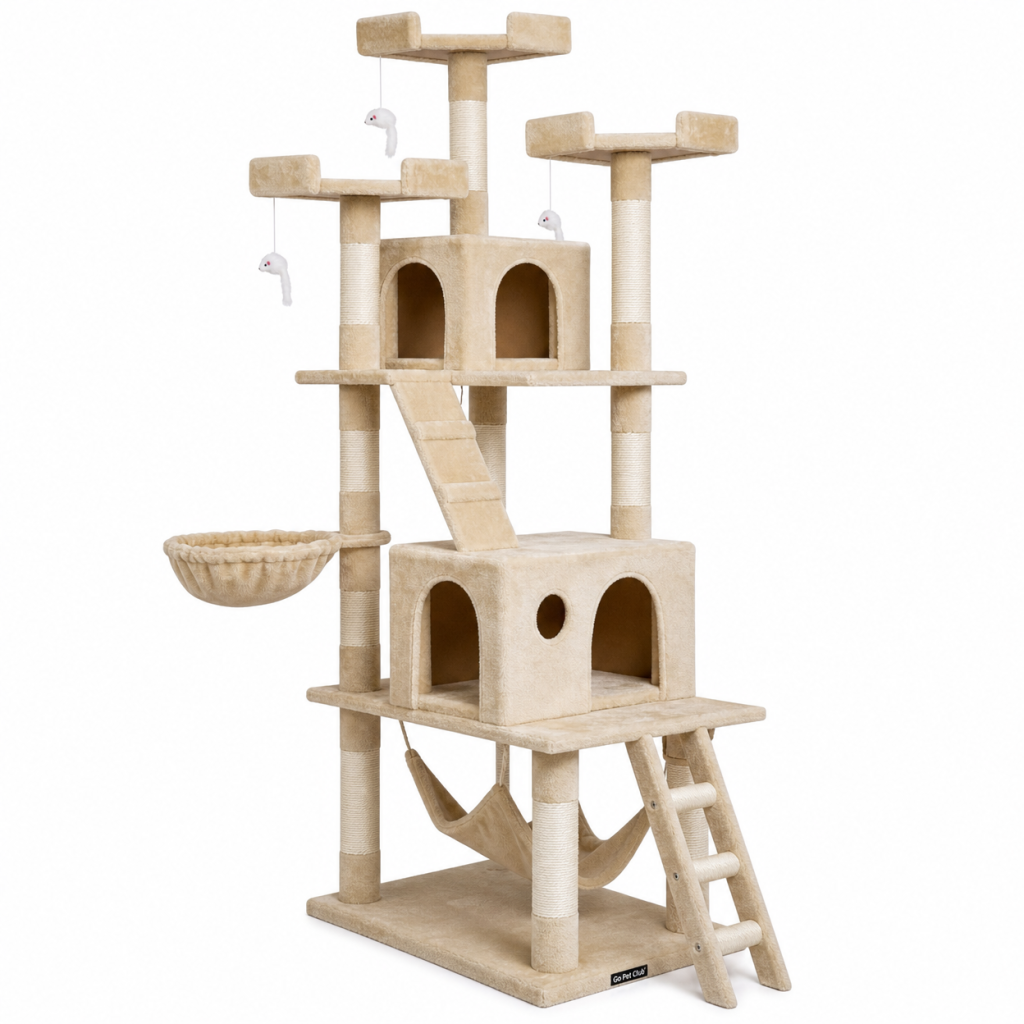
The Go Pet Club 72-inch tree features multiple platforms at varying heights, including traditional flat resting shelves, enclosed condos for cats that prefer private sleeping spaces, and hammock-style perches that many cats find particularly comfortable. The variety of platform types accommodates the different resting preferences of individual cats — some prefer open perches where they can survey their domain, while others seek the security of enclosed spaces that simulate the dens and burrows that wildcats use for safe rest. Having options means every cat in the household can find their preferred resting style.
The highest platform, at 72 inches, gives cats a commanding view of the entire room. From this vantage point, they can watch household activity, monitor windows for outdoor wildlife, and feel secure from any potential threats (including the family dog or young children). Many cats will claim the top platform as their primary sleeping spot, returning to it day after day. The platform is large enough for even a substantial Maine Coon or Ragdoll to stretch out comfortably, with a raised rim that prevents the cat from rolling off in their sleep.
The enclosed condos are another key feature. These box-like structures with entrance holes provide dark, warm, secure spaces that cats love for deep sleep. In multi-cat households, a cat who wants to escape from a more dominant housemate can retreat into a condo and feel safe. The condos are large enough for a cat to turn around and curl up inside, with soft padding on the floor. Some models have condos at two different heights, giving cats even more options for private retreats.
The hammock-style perch is a favorite for cats who like to sleep in a curved position. The fabric hammock suspends between support posts, creating a gentle cradle that conforms to the cat’s body. Many cats who reject flat beds will happily sleep in a hammock. The hammock is also a great spot for cats who like to be high up but prefer a softer surface than a wooden platform. The hammock is removable and washable, which is important because it will accumulate cat hair rapidly.
The base of the tree is wide and weighted to provide stability against the significant lateral forces that active cats generate when jumping, playing, and scratching. A wobbly cat tree creates a safety hazard and discourages use, as cats quickly learn to avoid unstable structures. The Go Pet Club’s base dimensions provide solid stability even when a large cat launches from the highest platform to chase a toy. The base is covered in the same plush material as the rest of the tree, so it blends in aesthetically and provides a soft landing spot for cats who miss their jump.
Scratching Surface Integration
Natural scratching behavior serves multiple purposes for cats — it maintains nail health by removing dead outer layers, it stretches the back and shoulder muscles, and it deposits scent from paw glands as a territorial marking behavior. The Go Pet Club tree integrates sisal rope-wrapped posts at multiple points throughout the structure, providing appropriate scratching surfaces that redirect the behavior away from furniture and carpets. By placing scratching posts at different heights and angles, the tree encourages cats to scratch in appropriate locations rather than on your sofa.
The sisal material is preferred by most cats over carpet alternatives because it provides the satisfying resistance and fiber shredding that makes scratching rewarding. The vertical posts at the base of the tree and along the support columns allow cats to fully extend their bodies while scratching — a posture that provides the full stretching benefit that horizontally oriented scratching surfaces cannot achieve. When a cat scratches a vertical sisal post, they engage their back, shoulder, and leg muscles in a full-body stretch that is both exercise and maintenance.
The sisal is wrapped tightly around the posts and secured at both ends to prevent unraveling. Over time, the sisal will become frayed and worn as your cat uses it — this is normal and actually desirable, as the frayed texture provides even more satisfying scratching. When the sisal becomes too worn to be useful, you can rewrap the posts with fresh sisal rope, extending the life of the tree. Replacement sisal is inexpensive and widely available.
In addition to the sisal posts, some platforms have carpeted surfaces that also serve as scratching options. While not as preferred as sisal, the carpet provides an alternative texture and can be useful for cats who were previously allowed to scratch carpeted surfaces. However, if your cat has a history of scratching wall-to-wall carpet, you may want to encourage use of the sisal posts instead, as scratching carpet can reinforce the behavior you are trying to redirect.
Plush Covering and Comfort
The platforms and condos are covered in soft plush material that retains warmth and provides cushioning for resting cats. Most cats find plush surfaces highly appealing for extended lounging, and the material choice reflects an understanding of feline comfort preferences. The plush is attached securely to the platform surfaces and should withstand normal cat activity without loosening or bunching. The material is also reasonably durable, resisting the pulls and snags that active cat claws can cause, though it is not claw-proof.
The plush covering is available in several colors to match different home décors. Common options include beige, gray, brown, and black, all of which are neutral enough to blend in with most interior design schemes. The color choice is not just aesthetic — lighter colors show cat hair more obviously but are easier to vacuum, while darker colors hide hair but may show scratches more. Consider your cat’s fur color when choosing the tree color; a cat with white fur on a dark tree will leave visible evidence everywhere.
For cats who like to knead (sometimes called “making biscuits”), the plush surface is ideal. The soft texture simulates the feeling of their mother’s belly, and many cats will happily knead the platforms before settling down to sleep. This kneading behavior is a sign of contentment and comfort, so a cat who kneads on their cat tree is a happy cat. The plush material is thick enough to withstand repeated kneading without tearing.
Cleaning the plush surfaces requires regular vacuuming to remove cat hair and dander. A handheld vacuum or the upholstery attachment of your regular vacuum works well. For deeper cleaning, the platforms are not removable on most Go Pet Club models, so spot cleaning with a pet-safe upholstery cleaner is the best option. Some owners cover the platforms with washable blankets or pet beds to protect the plush and make cleaning easier.
Assembly Considerations
A tree of this size requires assembly, and the Go Pet Club comes with the necessary hardware and instructions. The assembly process is manageable for most adults and typically takes one to two hours with basic tools. Proper assembly is important for both safety and stability — each connection point should be secured firmly to ensure the structure performs as intended when subjected to cat activity loads. Following the assembly instructions carefully and double-checking all connections before allowing cat access is strongly recommended.
The tree comes in multiple sections that bolt together. The instructions are illustrated rather than text-heavy, making them easy to follow even for those who are not handy. You will need a Phillips head screwdriver and possibly a rubber mallet to help seat some pieces. Having a second person to hold pieces while you bolt them together is helpful but not strictly necessary. The most challenging part is aligning the taller sections, as the tree becomes increasingly unwieldy as it grows taller.
Once assembled, the tree is quite heavy and not intended to be moved frequently. Choose a location carefully before assembly, as moving a fully assembled 72-inch cat tree is a two-person job. The tree should be placed on a level surface, and if your floors are uneven, you may need to use shims under the base to prevent rocking. A rocking cat tree is dangerous and will discourage use.
Placement Strategy
Maximizing your cats’ use of the tree requires thoughtful placement. Positioning the tree near a window provides cats with the natural stimulation of outdoor observation — bird watching, squirrel monitoring, and weather watching are all activities that cats find deeply engaging when given a suitable elevated viewing platform. A window-adjacent cat tree can occupy a cat constructively for hours each day, reducing boredom-related behaviors and providing environmental enrichment that indoor cats critically need. If possible, position the tree so that the top platform has a clear view outside.
Avoid placing the tree in high-traffic areas where it might be knocked into or where your cats might feel unsafe due to constant movement. Cats prefer to observe from a distance, so a corner location with good sightlines to the rest of the room is ideal. The tree should not block doorways or walkways, as this creates inconvenience for humans and may make cats feel trapped. A corner location also provides additional stability, as the walls prevent the tree from tipping in two directions.
If you have multiple cats, consider placing the tree in a room where you spend a lot of time, such as the living room or home office. Cats want to be near their humans, so a tree in an unused guest room will not get as much use as one in the family room. However, the tree should also have some quiet time each day when cats can rest without interruption. The balance is to place it where cats can observe family activity but also have periods of quiet.
Final Verdict
The Go Pet Club 72-Inch Cat Tree is an excellent value-oriented option for cat owners seeking to provide their cats with meaningful vertical territory, appropriate scratching surfaces, varied resting environments, and interactive play opportunities in a single structure. Its combination of height, platform variety, integrated scratching posts, and accessible price point makes it one of the most popular choices in its size category for good reason. For cat owners committed to providing their indoor cats with the enrichment they need to thrive, this cat tree represents a worthwhile investment in feline wellbeing. Your cats will thank you for giving them back the vertical world they were born to explore.
