Post
Best Catit Flower Fountain 2026: Encouraging Healthy Hydration Through Natural Flowing Water
May
Catit Flower Fountain: Encouraging Healthy Hydration Through Natural Flowing Water
Many cat owners underestimate how significantly hydration affects their cats’ long-term health, and how strongly many cats’ drinking behavior is influenced by the way water is presented to them. Cats evolved in semi-arid environments where still water was often stagnant and unsafe, while running water from streams and springs was fresh and reliable.
This evolutionary background explains why many domestic cats show a strong preference for moving water sources — a preference that the Catit Flower Fountain Water Fountain exploits brilliantly to increase voluntary water consumption and support urinary and kidney health in cats that would otherwise chronically under-drink from still water bowls. For cat owners concerned about their cat’s hydration, the Catit Flower Fountain is one of the most effective tools available.
The Moving Water Attraction
Cats with a preference for moving water commonly demonstrate this through behaviors that frustrate their owners — drinking from running faucets, pawing at still water bowls before drinking, drinking from glasses left on countertops, or appearing simply uninterested in their water bowl despite adequate fill.
These are not behavioral problems but expressions of an instinctive preference that the Catit Flower Fountain accommodates elegantly. If your cat exhibits any of these behaviors, they are telling you they prefer moving water. The fountain gives them what they want in a safe, convenient format.
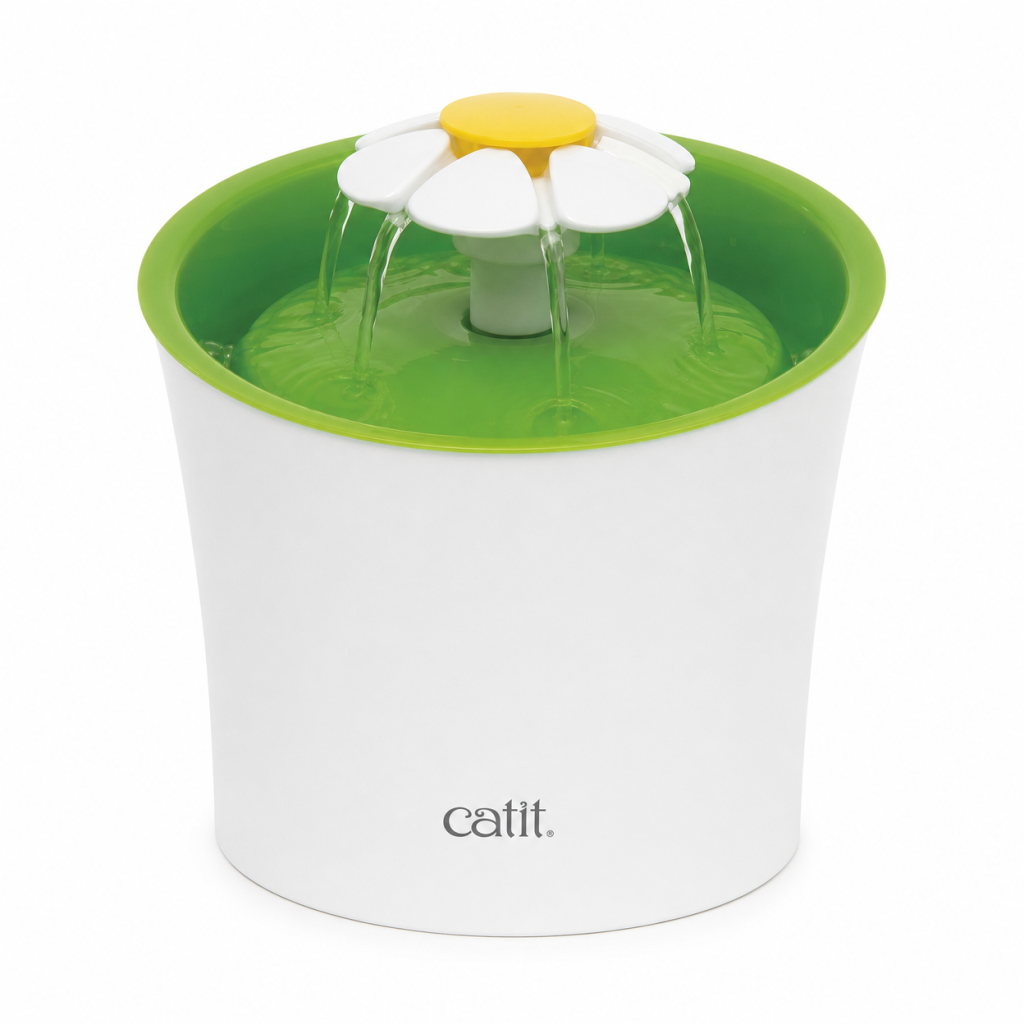
The fountain’s triple-flow design allows cats to drink directly from the flowing top center stream, from the gentle cascade that falls over the flower petals into the reservoir below, or from the reservoir surface itself — three distinct drinking positions that suit different cats’ preferences for approach angle, water height, and flow speed.
Most cats that express a preference for moving water increase their water intake substantially when provided with a fountain option, which translates directly into reduced risk of the urinary tract and kidney problems that commonly affect cats that chronically under-hydrate. More water intake means more dilute urine, which means fewer crystals, fewer blockages, and healthier kidneys over the long term.
The flower design is not merely decorative; it serves a functional purpose. The flower sits on top of the fountain and distributes the water flow into multiple streams. The petals create small waterfalls that aerate the water, increasing oxygen content and improving taste. The gentle splashing sound is attractive to cats, drawing them to the fountain. The flower can be removed for cleaning or replaced if damaged. Replacement flowers are available and inexpensive, so you can refresh the look of your fountain periodically.
The water flow is adjustable via a dial on the pump. You can increase the flow for cats who like a stronger stream or decrease it for cats who prefer a gentler flow. Some cats prefer to drink from the top stream, while others prefer to lap from the reservoir surface where the water is still but constantly refreshed. Observe your cat’s drinking behavior and adjust the flow accordingly. The fountain works well for both preferences.
Triple Filtration System
The Catit Flower Fountain filters water through a triple-stage system that improves water quality meaningfully. The first stage uses a foam filter that captures hair, food debris, and visible particulates that accumulate in a shared cat-and-human household environment. This foam filter is washable and reusable; rinse it under running water every time you clean the fountain and replace it every few months. The foam filter prevents debris from reaching the pump, extending the pump’s life and maintaining water quality.
The second stage uses an ion exchange resin that softens water by removing calcium and magnesium ions that can affect taste and leave mineral deposits on the fountain surfaces.
Hard water is not harmful to cats, but it can leave white scale on the fountain that looks unsightly and can be difficult to clean. The ion exchange resin reduces scale buildup, making the fountain easier to maintain. The resin is contained in a cartridge that must be replaced regularly; the replacement schedule depends on your water hardness.
The third stage uses activated carbon that removes chlorine taste and odor as well as various trace organic compounds that can affect palatability. Chlorine is added to municipal water supplies to kill bacteria, but it also gives water a taste that some cats find off-putting.
The activated carbon removes chlorine and other taste-affecting compounds, making the water more appealing to sensitive cats. The carbon also absorbs odors, keeping the fountain smelling fresh. The carbon cartridge should be replaced every 3-4 weeks for optimal performance.
The combination of these three filtration stages produces water that is noticeably cleaner tasting than unfiltered tap water, which may further improve cats’ willingness to drink in adequate quantities.
Filter replacement every three to four weeks is recommended to maintain filtration effectiveness, and replacement filters are readily available and reasonably priced. Some owners buy replacement filters in bulk to save money and ensure they never run out. The cost of replacement filters is modest compared to the veterinary costs of treating urinary tract disease.
Water Capacity and Reservoir Design
The fountain holds approximately 100 ounces (3 liters) of water — sufficient for one or two cats to drink without refilling for several days under normal circumstances. For multi-cat households with three or more cats, daily refilling may be necessary to maintain adequate water availability.
The wide, low-profile reservoir is accessible from all sides, allowing multiple cats to drink simultaneously without competition, and is easy to fill without removing the fountain from its location. The clear reservoir lets you see the water level at a glance, so you know when it needs refilling.
The reservoir is made from BPA-free plastic and is dishwasher safe (top rack). The wide opening makes it easy to clean by hand as well. The reservoir has a handle molded into the side for easy carrying.
The fountain should be placed on a level surface, and the reservoir should be fully seated in the base before filling to prevent leaks. The fountain has a low-water indicator that makes a slight sound when the water level drops below the pump intake; this tells you it is time to refill.
The fountain is designed to be tip-resistant. The low center of gravity and wide base make it difficult for cats to tip over, even enthusiastic drinkers. However, if you have a particularly rambunctious cat, you may want to place the fountain against a wall or in a corner for additional stability. The fountain should not be placed on carpet, as spills can occur during refilling or if the fountain is tipped. A waterproof mat underneath the fountain is recommended.
For owners going away for a weekend, the fountain can provide water for several days. However, you should still arrange for someone to check on your cats daily. The fountain is a supplement to, not a replacement for, daily care. The fountain should be cleaned and filters changed before extended absences to ensure water quality. Having a backup water bowl (a traditional bowl) is also wise in case of fountain malfunction.
Pump Maintenance and Noise Levels
The submersible pump that drives the water circulation is small but reliable, and requires regular cleaning to remove the biofilm that develops on wet pump components during normal operation. Neglected pump cleaning is the primary cause of reduced flow and noise issues in fountain pumps — a weekly pump rinse and monthly disassembly and thorough cleaning maintains the pump in efficient, quiet operation.
A clean, well-maintained Catit Flower Fountain operates at a noise level that is barely audible from a few feet away, appropriate for bedroom placement if the cat’s preferred drinking location is near the sleeping area.
To clean the pump, unplug the fountain, remove the pump from the reservoir, and disassemble it according to the instructions. The pump impeller (the spinning part) can become clogged with hair and debris; clean it with a small brush or toothpick. Rinse all components with warm water and reassemble. Do not use soap on the pump internals, as soap residue can affect water taste and may harm your cat. A vinegar soak can remove mineral deposits if your water is hard.
If the pump becomes noisy, it is usually because it needs cleaning or because the water level is low. Check the water level first; a pump running dry will make noise and can be damaged. If the water level is adequate, clean the pump. If the noise persists after cleaning, the pump may be failing and should be replaced. Replacement pumps are available from Catit and are reasonably priced. Keeping a spare pump on hand means you can replace it immediately if the original fails.
The fountain should be unplugged during cleaning and when the water level is very low. The pump should never run dry; doing so will damage it. The fountain uses very little electricity — about the same as a night light — so it can be left plugged in continuously. The pump is designed for continuous operation and will last longer if left running than if turned on and off frequently. The constant water movement also prevents stagnation, so leaving the fountain on is beneficial.
Materials and Food Safety
The Catit Flower Fountain is available in both BPA-free plastic and stainless steel versions, allowing owners to choose based on their cats’ material sensitivity preferences and their own maintenance preferences.
The stainless steel version is the better choice for cats that have shown sensitivity to plastic bowls, while the plastic version is lightweight and equally safe for cats without demonstrated sensitivities. Stainless steel is also more durable and easier to clean, though it is more expensive and can be noisier than plastic (the sound of water on metal may be audible).
The plastic version is made from BPA-free, food-grade plastic that is safe for cats. The plastic is clear or translucent, allowing you to see the water level easily. The plastic is durable and resistant to cracking, but it can develop scratches over time. Scratches can harbor bacteria, so the stainless steel version is preferable for cats with compromised immune systems or for multi-cat households where hygiene is a particular concern. The plastic version should be replaced every few years as scratches accumulate.
The stainless steel version is made from 304 stainless steel, the same grade used in commercial kitchens. Stainless steel is non-porous, so it does not scratch in the same way plastic does, and it is naturally antimicrobial to some extent. The stainless steel version is heavier than the plastic version, which makes it more tip-resistant.
The stainless steel version is also less likely to develop odors or stains. The main downside is that the stainless steel can be noisy — the sound of water hitting metal is louder than water hitting plastic. Some cats are sensitive to this noise, while others are not.
Both versions use the same pump and filtration system, so the maintenance and operation are identical. The choice between plastic and stainless steel is largely a matter of personal preference and your cat’s specific needs. If your cat has never shown sensitivity to plastic, the plastic version is fine and more affordable. If you want the highest durability and hygiene standards, or if your cat has plastic-related skin issues, the stainless steel version is worth the additional cost.
Final Verdict
The Catit Flower Fountain is an effective, well-designed hydration solution for cats that resist drinking adequate water from still bowls — which represents a significant proportion of the domestic cat population. Its moving water presentation, triple filtration, accessible reservoir design, and reasonable maintenance requirements make it one of the best-value cat water fountains available.
For cat owners whose cats show faucet-drinking behavior, bowl-pawing, or other signs of preferring moving water, the Flower Fountain is a straightforward investment in long-term urinary and kidney health that most cats accept enthusiastically from the first interaction. It turns drinking from a chore into a pleasure.
